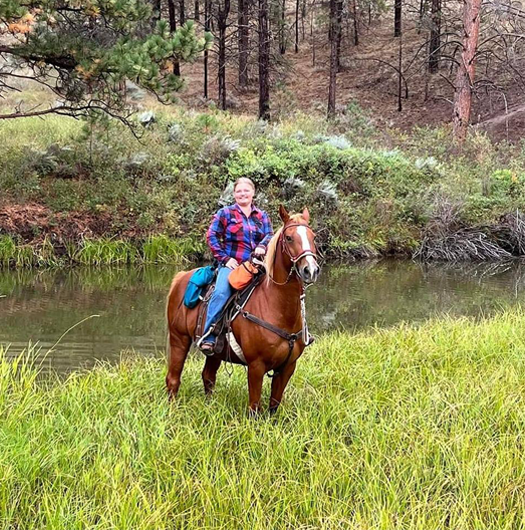

✨ Note to Readers: It’s been a few weeks since my last post. Life has a way of stirring up chaos at the end of a cycle, clearing space for the new one to begin. Thank you for giving me the grace to pause, process, and return with fresh perspective.* ✨
Equine Core Relaxation: Diving Deeper
It’s been three weeks since my last post. At first, I thought I’d come home from my third clinic with Tanya and immediately share everything I’d learned about Equine Core Relaxation, a powerful form of equine bodywork. However, the last few weeks have been chaos. They marked the end of a cycle so that a new one could begin. I needed time to process, to reset, and to find the words.
A New Step in Equine Core Relaxation
This clinic felt like stepping onto a new stretch of trail. The first two gave me glimpses of how anatomy, movement, and energy all connect. Even so, I’ll be the first to admit—I’ve only scratched the surface. Anatomy is a wide-open country, and learning it takes time. Still, if I can commit to learning just 1% each day, in 100 days I’ll have made 100% progress. A journey of a thousand miles begins with a single step, and this clinic was one of those steps.
How Equine Core Relaxation Works
Equine Core Relaxation works through the nervous system. It stimulates the nerve cells in the muscle bundles. These cells then send a signal to the brain’s central pattern generator. The brain resets itself and sends back a new signal of neutrality. As a result, the muscles begin firing in balance.
Muscle is what holds bone in place. When muscle returns to proper tone, the skeleton can often float back into its ideal position.
💡 Anatomy Nugget: Central pattern generators (CPGs) are networks of cells that can produce motor responses even without sensory or brain inputs. These responses are well-rehearsed, repetitive, and unconscious. For example, walking, chewing, and breathing all run through CPGs. Equine Core Relaxation taps into this reset system and allows the body to return to balance on its own.
A Lesson from the Clinic
On day two, Echo and I worked through an exercise that deepened what I’ve already been practicing. For quite some time, I’ve trained myself to notice even the smallest imbalances—a shift in stride, a whisper of muscle tightness. This clinic wasn’t about learning to see them. Instead, it was about refining how I respond. I focused on placing my hands with precision and directing my energy with clear intention.
I’ll admit, I have a habit of getting distracted by the little things I pick up—“chasing rainbows,” as Tanya calls it. However, once the neurological syndromes are addressed, most of those rainbows fade away on their own. Therefore, my homework is to keep working on identifying those syndromes and to look at the bigger picture behind the small imbalances. The changes I felt in Echo this weekend were subtle but real. Even so, they reminded me that progress comes both in the details and in the discipline to step back and see the whole.
Finding Quiet Confidence
Somewhere in learning Equine Core Relaxation, I found a quiet confidence. This isn’t the kind of confidence that claims mastery—because I haven’t mastered anything. Confidence like that comes only with time and practice. Instead, it’s the quiet certainty that I am equal to the task and able to put forth my best effort.
Following the Gifts
Life is about the journey, not the destination. I want to thank Tanya for opening this door, for giving me the chance to learn, and for believing that I can do this. I finally feel like I’m on the right path—that this is the work I’m meant to pursue. I’ve always known God called me to horses, gave me this gift of feeling and seeing more. Now I am following my gifts and my passion, and they are leading me exactly where I’m meant to be.
Your Turn
And to you, reading this—if you’ve been searching for your spark, don’t ignore it. Look deeper. Find your why. Your passion is what will move you to your purpose.